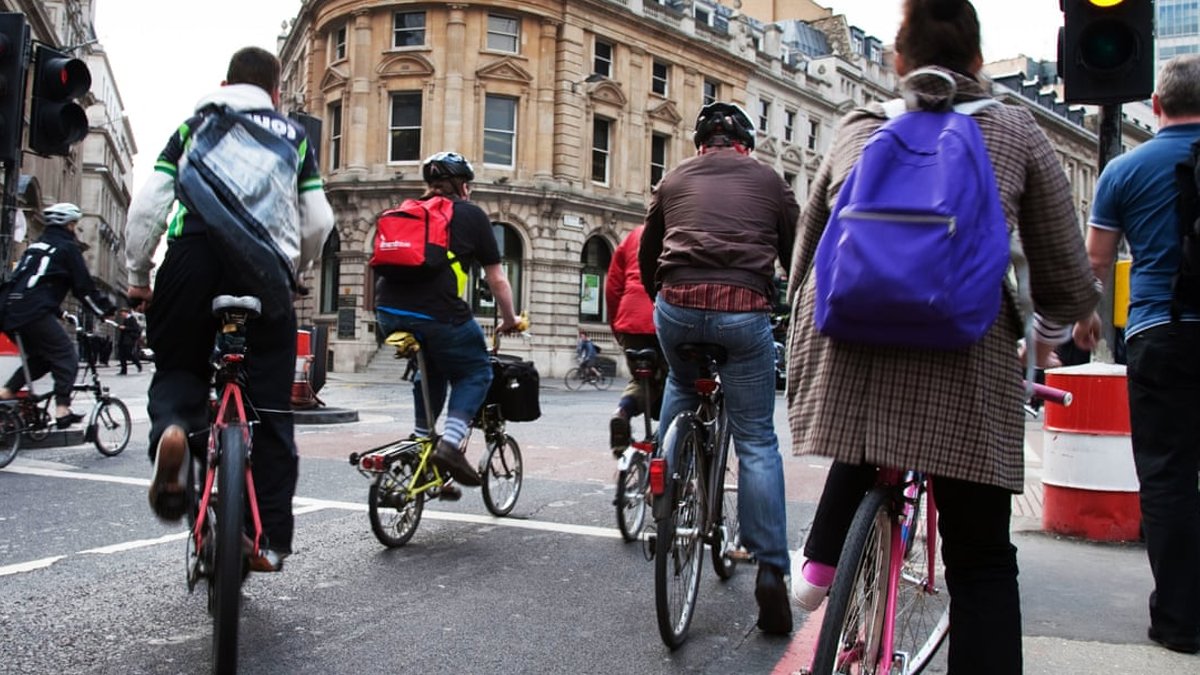
British cyclists who run red lights have drawn sharp rebukes from fellow riders and pedestrians, with one woman describing two separate collisions that left her injured and the riders fleeing the scene. The letters respond to a recent opinion piece by Simon Jenkins, who argued that Britain’s traffic laws feel overly bureaucratic and suggested that cyclists should not always be bound by them.
Jenkins pointed to the philosophy of Hans Monderman, a Dutch traffic engineer who championed “shared space” — removing traditional road markings and signals to force road users to negotiate with each other through eye contact and caution. But critics say that argument misreads Monderman’s work entirely.
The Argument Over “Shared Space”
Gary Ogin, writing in response to Jenkins, said Monderman never advocated for anarchy or for individuals to cherry-pick which laws to follow. His idea, Ogin argues, was to remove infrastructure precisely to compel collective cooperation and mutual caution.
“The moment cyclists ignore that negotiation process while vulnerable pedestrians are left unprotected, the delicate psychological balance collapses,” Ogin wrote. “Freedom without universal accountability isn’t shared space. It is just a system that rewards the most aggressive road user.”
Related: Stars rally against AI voice cloning
That point is not merely theoretical. High-profile shared-space implementations, including London’s Exhibition Road, faced fierce backlash and were eventually reversed. The UK government also halted new level-surface shared-space projects when it became clear that compliance breaks down.
When that happens, it is blind and elderly people, along with other vulnerable pedestrians, who pay the price for an idealised view of human nature. The gap between the theory of shared space and its real-world application has proven to be a persistent problem — one that tends to surface only after someone gets hurt.
Cyclists Push Back on Jenkins
Not all cyclists agree with Jenkins. Peter, from West Yorkshire, described himself as a lifelong cyclist and offered a different take on traffic lights: they provide unplanned fartlek opportunities on training rides, a chance to practice track stands, and rest breaks when needed.
“I’m not sure Jenkins’ anarchic behaviour and justification for it does much to help the case of cyclists,” he wrote.
Edward Collier, who rides a bike, a motorbike, and drives a car, said he stops at red lights on all three. He warned that cyclists who ignore traffic signals contribute to growing antagonism toward riders in general. “Simon Jenkins should know better,” he said.
Related: Resolution 2803 Reveals Hidden UN Veto Power
Personal Costs and a Pattern of Incidents
Joan Grabham, 87, of Cambridge, offered the most direct account of what happens when cyclists decide not to stop. Four years ago, at age 83, she was knocked down by a young man on a bike, damaging her wrist. He rode away quickly after making sure she wasn’t dead.
This April, she was knocked down again on a pedestrian crossing, this time by a black e-bike. The incident left her with a deep wound on her leg and required police, ambulance, and hospital treatment. Four months later, the leg is still being treated. The rider rode off after making sure she wasn’t dead.
“Shame on you, Simon Jenkins,” she wrote.
The letters reflect a growing frustration among pedestrians and law-abiding cyclists alike. The debate is unlikely to settle soon, but the personal accounts add weight to the argument that red-light running is not a victimless act. For Grabham, the cost has been physical and ongoing — and the riders who hit her have never been held accountable.


